CLVR Benefits: from built product to paying customers.
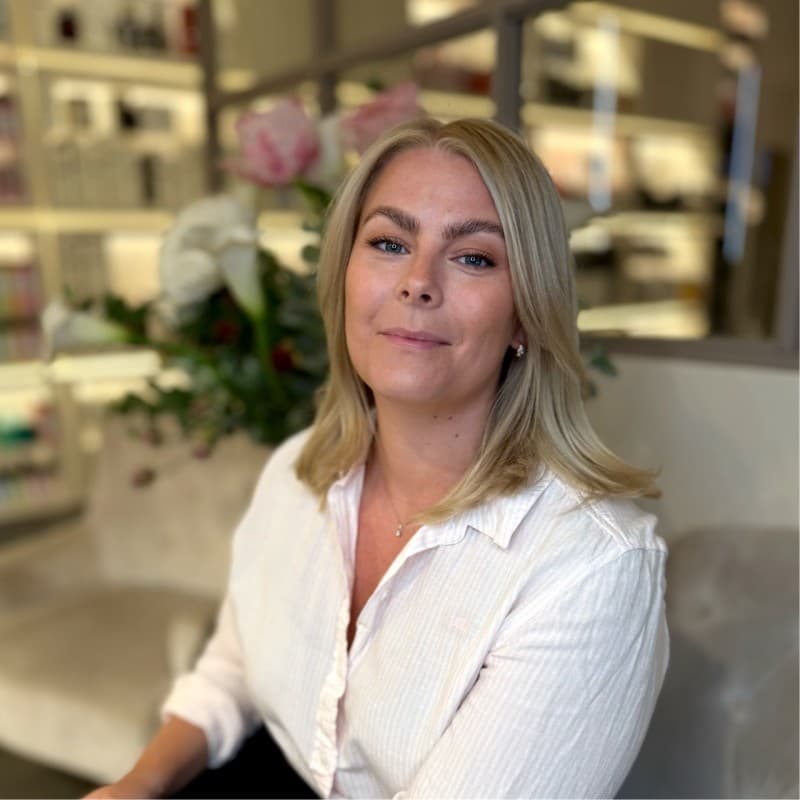
Caroline spent fifteen years as an HR business partner before she built CLVR Benefits with a technical co-founder. By the time she came to DQ the platform was live, GDPR compliant and tax compliant. What it did not have was a paying customer, a price tested against a real buyer, or a route to market.
What was the challenge?
Caroline Sandqvist spent fifteen years as an HR business partner before she started CLVR Benefits. The idea came from a problem she owned herself. Mid-pandemic, salaries at her employer were spiking and she went looking for a flexible benefits platform that would work under Swedish benefit taxation. Every vendor said the same thing about the Nordics: too complex, we won’t do it. Her employer eventually bought what she calls a glorified spreadsheet on a two-year contract and never launched it to employees.
So Caroline recruited a technical co-founder and built the product herself, over roughly eighteen months of evenings and weekends. By the time she approached DQventures the platform was live, GDPR compliant and tax compliant. It had no customers, no price tested against a real buyer, and no route to market. Caroline was also direct about the gap: selling was the part she expected to struggle with.
What she needed:
- A structured way to find out whether Swedish HR and finance leaders would actually pay, rather than tell her the idea sounded good.
- Positioning that separated CLVR from the perks marketplaces and voucher providers Swedish buyers dismiss.
- A repeatable sales process she could run herself, built around how she sells best rather than how sales is supposed to be done.
- All of it without either founder leaving their income, which ruled out every accelerator they looked at.
What did we do?
Product was the one thing CLVR did not need help with, so the work went almost entirely into demand.
- Problem and demand validation. Structured discovery interviews with named HR and finance leaders at Swedish employers, using a script designed to surface behaviour rather than opinions. Fifty-plus buyer conversations, documented and analysed.
- Positioning and messaging. A messaging framework that put compliance first and named the real buying unit as HR and Finance together. CLVR stopped competing as a benefits platform and started competing as finance-grade infrastructure: auditable reporting, payroll-ready exports, and a cost ceiling that includes employer social fees.
- A sales process she could run. An ICP of Swedish software and services companies between 25 and 200 employees. CRM pipeline stages from cold prospect through to live customer, lead lists, call scripts, a discovery-call structure, qualification criteria, and an objection and FAQ library for the demo.
- Analysis of her own sales calls. Her recorded calls were worked into five buyer archetypes and the objections each one raises. The dominant blocker turned out to be incumbent lock-in — one to three year auto-renewing contracts with the established Swedish providers — which reframed a slow pipeline as a timing problem rather than a demand problem.
- Demand generation shaped around the founder. A Swedish benefits guide as a lead magnet with a follow-up email sequence, paid campaigns, and branded case studies of her first two customers as sales collateral. When testing showed Caroline converts best in rooms of thirty to fifty people, the plan moved to small in-person events rather than pushing a channel she disliked.
What were the results?
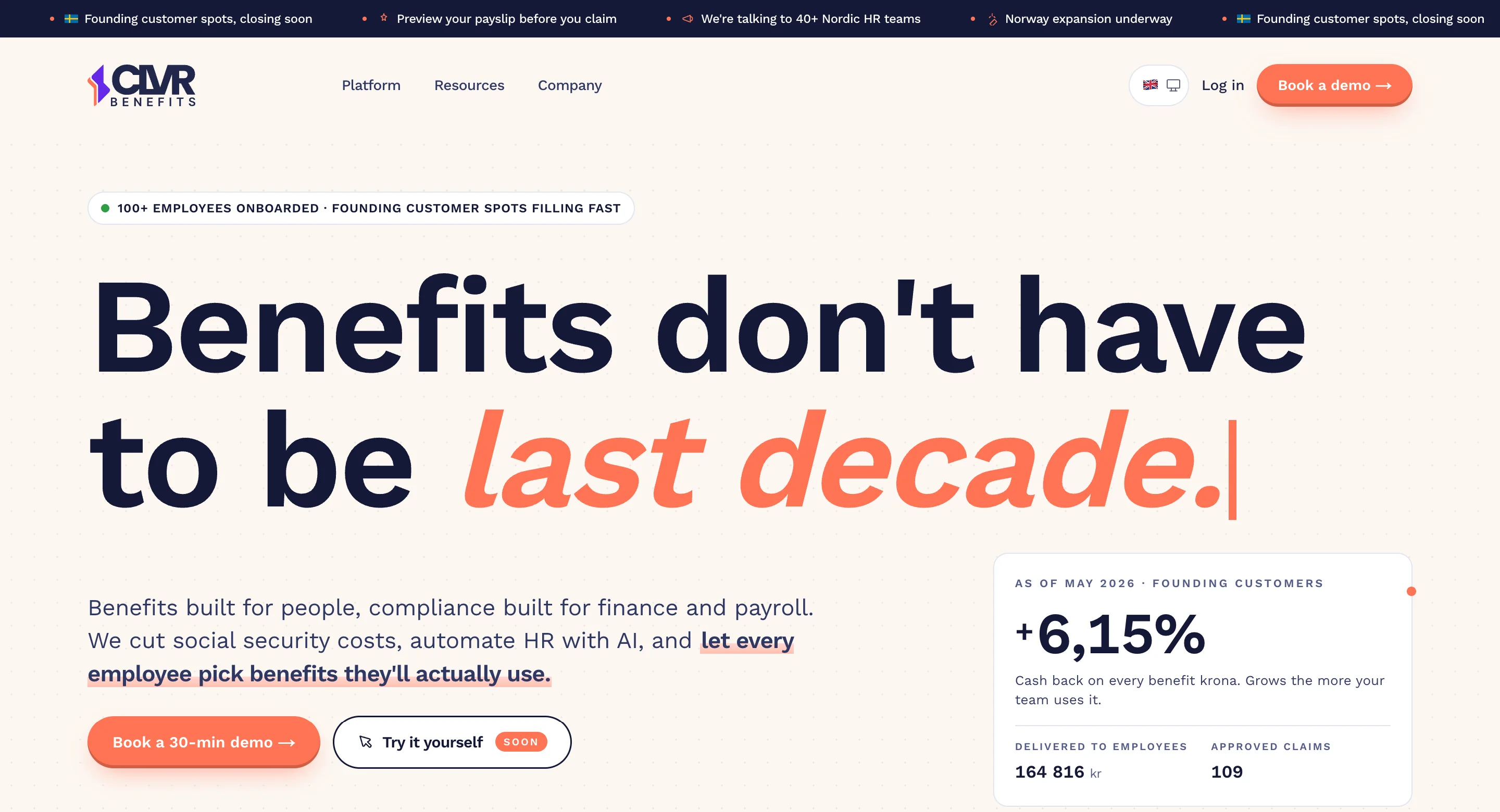
CLVR went from no revenue in 2024 to 42,094 SEK in its first commercial year, and licence revenue for 2026 is projected at 90,100 SEK across existing clients plus one new launch in September. These are small absolute numbers and CLVR presents them that way to its own board. What sits behind them matters more: paying customers who renew, a client asking to be taken into a second country, and a qualified pipeline several times the size of current revenue — all built without a funding round, with no employees, and without either founder giving up their income.
Key outcomes:
- Customers who stay. The first paying customer renewed for a second year. Churn since launch is zero, and a client signed four months earlier asked CLVR to launch them in Norway — a market Caroline had never worked in.
- A pipeline worth roughly 508,000 SEK a year. Four qualified accounts: a 60-person software company approved and contracting for a September launch; a 1,000-person healthcare group with CEO sign-off, growing to 5,500 through acquisition and opening a route to a 15,000-employee parent group; a 60-person manufacturer with a completed financial business case; and an 800-person technical services group that has already terminated its incumbent contract.
- The raise was stopped on purpose. A pre-seed process was prepared and then abandoned in favour of bootstrapping. On 1,739 SEK a month of burn and 23 months of runway, external capital would have cost more in equity than it bought in speed.
- Selling became something she does. Talking publicly about the business started producing inbound leads, including a 3,000-employee company well beyond the original ICP. The founder who expected sales to be her weakness now runs the pipeline herself.
- Nobody quit. Two years in, Caroline still consults in HR and her co-founder still builds around his own commitments. CLVR is growing into a business that can pay them, on its own timeline.
Hear it from Caroline
We interviewed Caroline for our Founder Stories podcast. Watch the full conversation below.
Read more founder stories.

Rob, Singapore
WeNetwork
After a long career in senior recruitment roles around the world, Rob came to DQ to help him start WeNetwork — now placing talent across multiple countries in Asia.
Read the case study
Rachel, Australia
Juurnee
Rachel had the idea for Juurnee after needing help on a Sydney-London flight with her three kids. It now matches travellers who need a flight companion with people paid to fly alongside them.
Read the case study
Steve, Australia
Zenn
Steve was a designer in Sydney who got tired of watching good design get bottlenecked. Zenn was his answer — an AI-powered design platform that puts beautiful branding in everyone's hands.
Read the case study
Richard, UK
DealerDoc
Richard spent over a decade running car dealerships before coming to DQ to validate his idea for DealerDOC — custom software that drags dealerships out of spreadsheets and into the 21st century.
Read the case study
Toby, Portugal
Blue Mongoose
Toby kept watching startups lose months building things they could have tested in weeks. Blue Mongoose is his fix — getting founders to a working MVP, fast.
Read the case study
Pat, Singapore
Duellix
Pat and Dan came to DQ to explore a business idea that failed validation — but with DQ's help, they founded Duellix instead. Duellix takes the boring stuff — incorporation, payroll, tax, corporate secretary — off the plates of founders running businesses in Singapore.
Read the case study
Marcello, Switzerland
Common Synapse
Marcello spent eighteen years in pharma, biotech and consumer before building Common Synapse — turning what patients say in public into evidence biotech CEOs can use for their biggest decisions. Four paid engagements in his first six months.
Read the case study