The Four Quadrants: how we work out whether an idea is worth your career
Most people who apply to DQventures arrive with at least one idea and a version of the following question: is this any good?
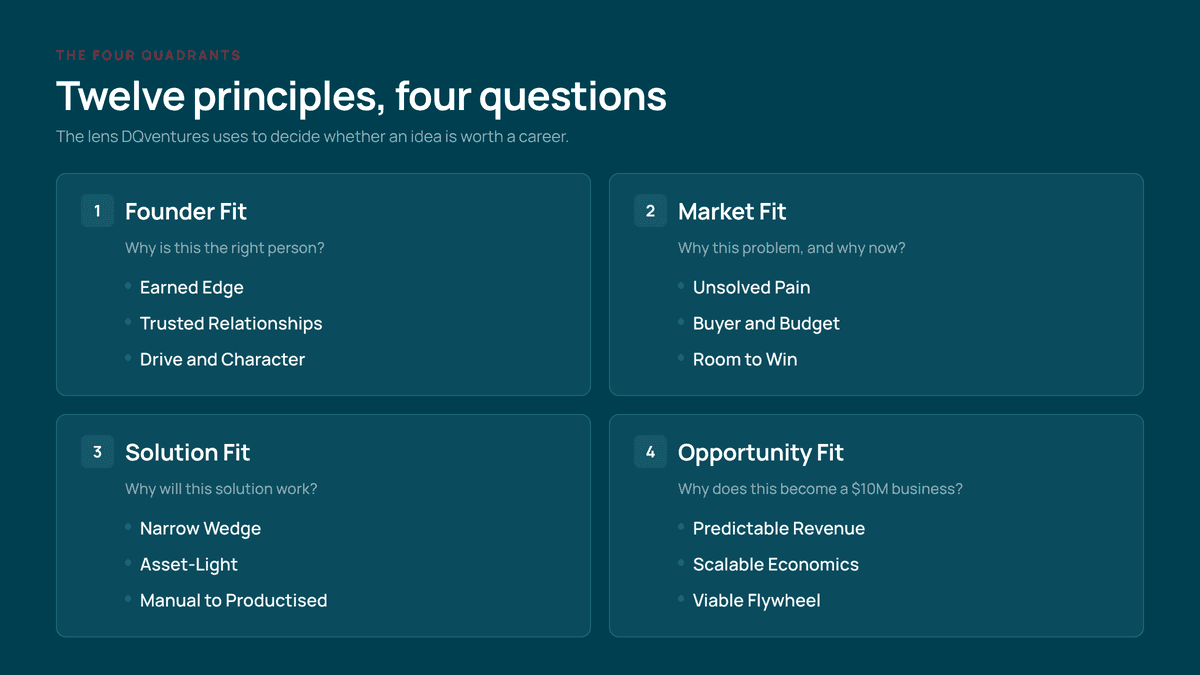
To answer this question properly, we apply our twelve business building principles, divided into four parts. We call these the Four Quadrants.
This is the lens we use to decide which founders to back, and the red thread that runs through everything we do as we build companies from zero to one. If you end up working with DQventures, you'll become very familiar with these principles and hopefully adopt them as part of your own entrepreneurial philosophy.
Here's how it breaks down.
Why we bother with a framework
Personally, I've invested directly in more than sixty companies and started several of my own. Looking back at the ones that went wrong, very few failed because the idea was stupid. They failed because one part of the business was obviously weak and everyone involved, me included, focused too much on the strong parts instead.
A founder with twenty years of hard-won domain knowledge and no route to an actual buyer. A real, expensive problem sitting in a market where nobody holds a budget line for solving it. A genuinely clever product that needed a team and a funding round before a single customer could try it. In hindsight, each of those issues was visible from the start. I just didn't realise it at the time.
The Four Quadrants exists to ensure the uncomfortable questions get asked early, instead of spending eighteen months to find out the hard way.
Quadrant 1. Founder Fit: why is this the right person?
We start with you rather than the idea. Ask any experienced early-stage investor what makes a small business work in its first two years and they'll almost all tell you it's the founder.
Earned Edge is insight or access that took years to build and maps directly onto what you're selling. The test we apply is simple: how long would someone starting from scratch need to build what you already have? If the answer is a few weeks of reading, it isn't an edge.
Trusted Relationships means you already know the people you'd need to sell to. Your first ten conversations happen through a warm introduction rather than a cold campaign. This is the single biggest advantage an experienced professional has over a younger founder, and it's the one most often left unused.
Drive and Character is perhaps the least obvious to a first-time founder, but they're often quite obvious to people who back startups for a living. You need to ask yourself: how comfortable are you with risk, uncertainty and chaos, really? Will you be happy committing an unreasonable amount of time to running every part of a business, including the boring parts, even if the easy wins never arrive? How long can you afford to spend on this before you run out of patience and personal runway? It's much better to name the risk now than pretend it isn't there.
Quadrant 2. Market Fit: why this problem, and why now?
Unsolved Pain asks whether people know they have the problem and are already spending time or money working around it. Someone maintaining a horrible spreadsheet for six hours a week is better evidence than someone agreeing your idea sounds useful. Agreement is cheap. Workarounds cost something, which makes them meaningful.
Buyer and Budget is about who can say yes. Not who would like it, or who would benefit, but the specific person with authority and a budget they already spend on problems of this shape. Plenty of businesses fail with delighted users and no buyer.
Room to Win covers the gap competitors have left open and the reason it's open right now. Sometimes that's a regulatory change, sometimes a shift in technology, sometimes an assumption every incumbent makes that turns out to be wrong. If you can't explain why nobody has done this yet, either you're missing something or someone already has.
Quadrant 3. Solution Fit: why will this solution work?
This quadrant is where most ideas get smaller, and founders often find that frustrating for a while before they find it liberating.
Narrow Wedge is the smallest version of the business you can put in front of a real customer quickly. A wedge is a specific trigger moment, not a customer type. "Operations directors in mid-market manufacturing" is a segment. "The week an operations director gets their audit findings back" is a wedge. One you can build a test around. The other you can't.
Asset-Light means you can deliver something valuable with your own time and some light technology. No team, no infrastructure, no raise before you're allowed to sell. Many founders come to us assuming they need to raise from VCs. These days, this is rarely the case. For DQ founders, this is the principle that makes it possible to do all this while you're still employed.
Manual to Productised is the sequence. You deliver the value by hand first, because that's how you learn which parts customers actually care about. Then you automate the parts you now know matter. Building the product first means guessing, and guessing is expensive.
Quadrant 4. Opportunity Fit: why does this become a $10M business?
We back businesses that can reach roughly $10 million in enterprise value within five to ten years. $10m of enterprise value means roughly:
- Services: £1.5–2.5m revenue at 30–40% margin, so £600k–900k EBITDA, at 8–12x for something productised with recurring contracts.
- Vertical software: £1.5–2m ARR at 4–6x, needing maybe 250–400 customers at £5–8k.
- Staffing or brokerage: needs more revenue because multiples are 4–6x.
Let's use software for this example. In practice you need to get to $500k of ARR as quickly as possible, then hold year-on-year growth above 40%. At that rate, $500k becomes around $1.9M of ARR within another five years, which at a five to six times revenue multiple lands between $9.6M and $11.5M.
Three principles determine whether that's plausible.
Predictable Revenue asks whether revenue recurs once a customer is won. A fixed quarterly cycle, a subscription, a repeat need built into how the customer operates. One-off sales mean you start again every month.
Scalable Economics asks whether each sale makes money and whether that holds as you grow. Usually this means delivery gets cheaper per customer as the work gets codified, or revenue climbs while headcount stays flat.
Viable Flywheel asks whether each customer makes the next one easier to win. A referral loop inside a tight community. Data that sharpens the product. A roadmap that grows revenue per account over time. Without one of these, growth stays a function of how much effort you put in, forever.
The bar rises as you go
The twelve principles don't get answered once and ticked off. We use them to guide the development of the business throughout its lifetime, all the way to a sale.
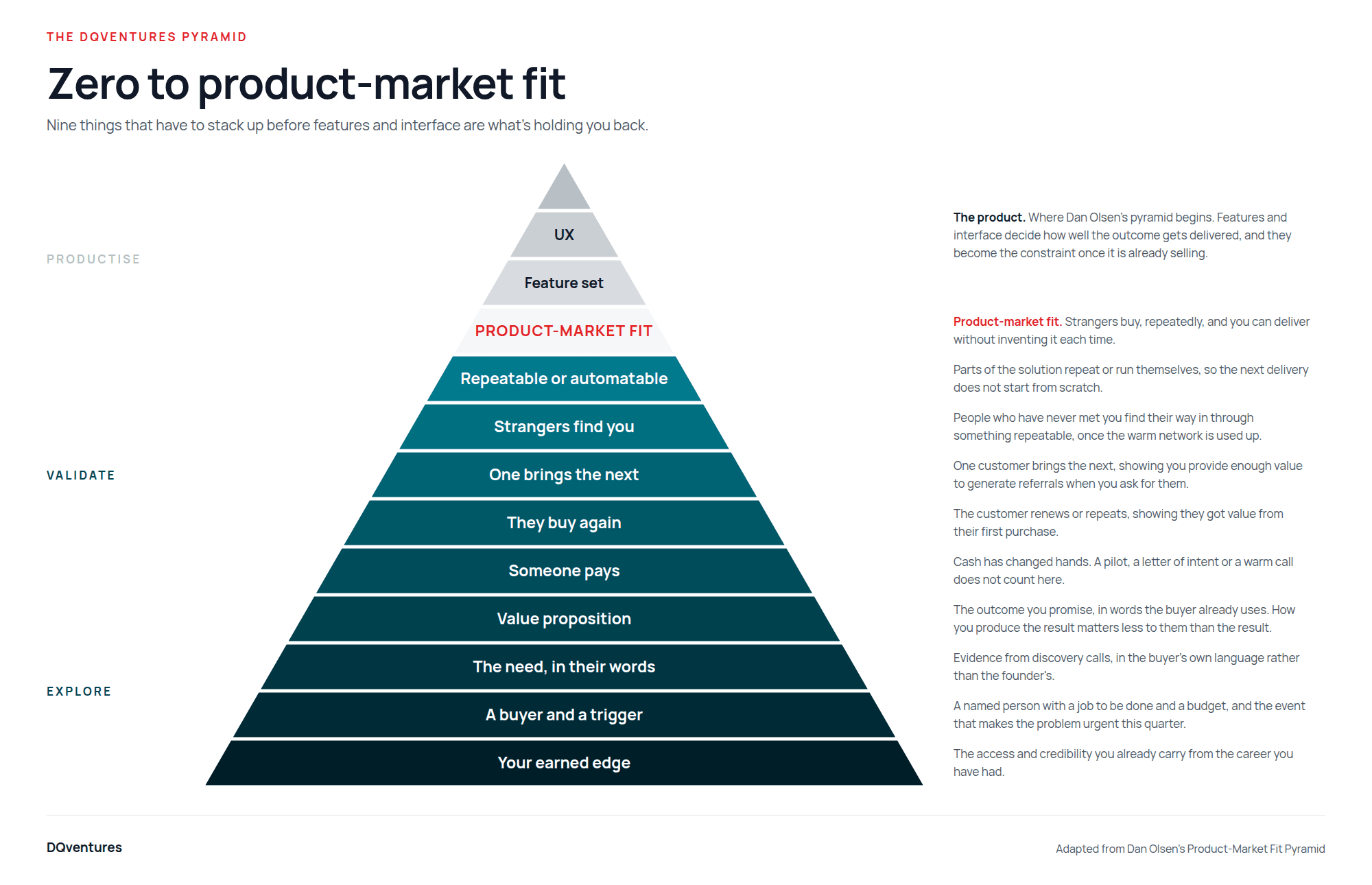
In Explore, we're trying to establish if "I Believe". The evidence is qualitative and comes from conversations with real buyers. It's strong enough to bet on, but it isn't proof.
In Validate, we're working towards "I Know". Someone pays. That's the moment belief converts into something you can build on, and it's the reason we push so hard on the narrow wedge and asset-light delivery. Both exist to get you to a paying customer sooner.
In Scale, it's all about "I Show". Growth metrics demonstrate the business repeats and compounds.
What this actually feels like
At the end of Explore we write an assessment against all twelve principles, and we say plainly which ones the evidence supports and which it doesn't. Some come back unconfirmed. It's not always easy reading, but we've learned it's better to take a straight approach to an idea's weaknesses than ignore them. Thanks to the Four Quadrants, the worst case should be realising your business wasn't as good as you initially believed it to be, while you still have a salary.
Ideas often die in Explore, but almost as often they're superseded by unexpected discoveries and opportunities that weren't obvious at the beginning. Over the years we've discovered that good ideas tend to get gradually better as you look at them more closely; weak ideas get steadily worse. It's worth spending some time to understand which bracket yours falls into.
If you're weighing up whether to invest in your idea, try applying the twelve principles yourself. The ones you can answer immediately are probably your strengths. It's the others you'll need to spend most of your time on.
 All twelve in one place, with the question each one asks. Worth keeping to hand as you work through your own idea.