Two clients, four scopes of work and a referral: how Common Synapse became a business
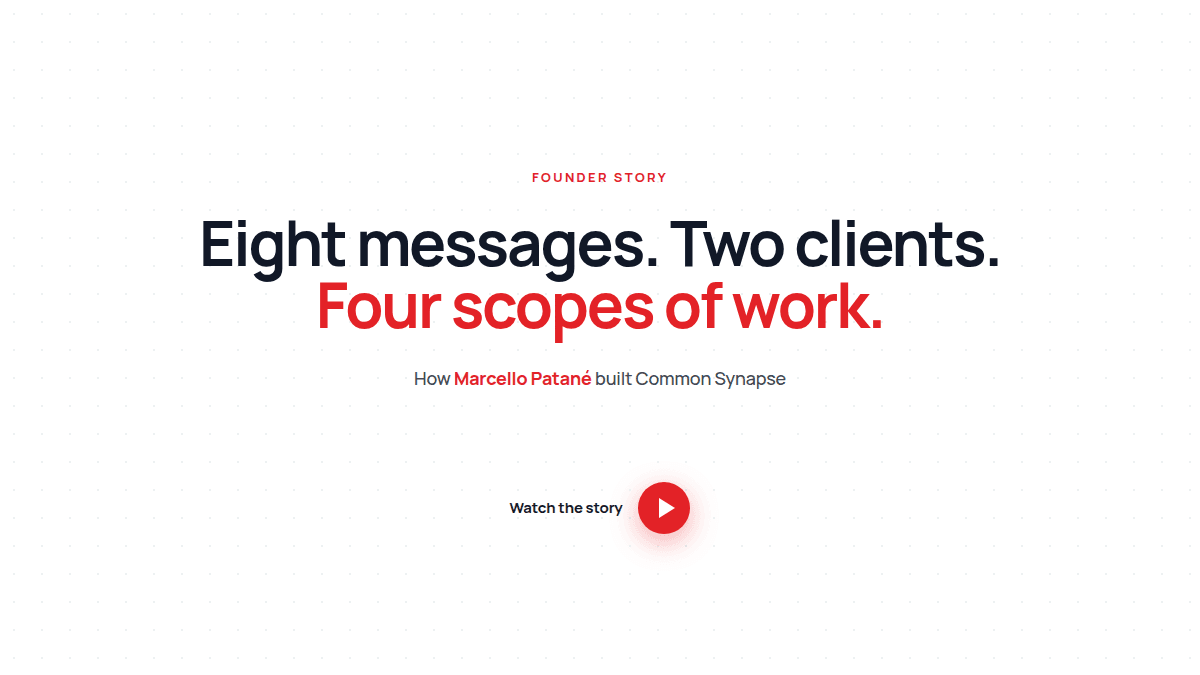
The question we get asked most by founders considering DQ is what they actually get for the equity. Traditionally we told people you get "a year of hands-on work and a long list of deliverables". For some, that wasn't enough detail, so as well as spelling this out on this updated website, we've started documenting our founders' journeys in film. Here's the latest one:
Below is the same story, including some of the parts the four-minute film had to leave out.
The problem he could see
Marcello Patané spent 18 years in insight work across pharma, biotech and consumer, at Nestlé, Novartis and Biogen. He had watched the same thing happen repeatedly.
 Marcello Patané, founder of Common Synapse.
A biotech founder makes a sensible guess about what patients need. It is a reasonable guess, built from clinician opinion and internal thinking. Then it gets built into the founder's fundraising story, and the clinical trial, and the targets, and everything gets locked down. By the time anyone finds out whether patients recognise the problem being solved, the decision is already expensive to undo.
Marcello knew the problem better than almost anyone. What he didn't have was a working solution.
The first idea was too much too soon
The first version of Common Synapse was a social listening platform with AI. It made sense on paper, but as many software founders come to realise too late, selling hundreds of low-ticket software subscriptions is no small challenge.
We helped Marcello conduct eight calls with people he used to work with. These calls quickly revealed that nobody wanted more data and nobody wanted another dashboard, because they were already drowning in both.
His own words afterwards were that he shouldn't build another piece of software, he should make the existing real-world data usable. That is the pivot the whole business turned on, and it happened in month one rather than month eighteen. Eight conversations is not much to ask of an eager founder, but the truth is most founders skip them. This is probably due to three factors: it's hard work, calling people is more intimidating than imagining features, and deep down, every founder is afraid of being told their idea won't work.
Narrowing to one buyer
The business Marcello ended up building was much more realistic than the version in the deck. Out went all of pharma and biotech, which he could never reach on his own. What was left was one buyer profile: an early-stage biotech founder, weeks away from a decision on fundraising, trial design or endpoints, working in neurology.
It wasn't a sexy SaaS startup (which most founders have no idea how to build, by the way), but a pre-market patient insight practice, which reads what patients say in public and turns it into evidence, coded and traceable back to source, delivered in weeks.
Working with Marcello, we built the things a practice like that needs before anyone will buy from it. A brand: wordmark, palette, type system and a set of drop-in components, all locked into a Claude design system that could quickly spin up subsequent design assets with the right look and feel. A domain and an inbox warmed up so his outreach didn't automatically divert to spam. A website that explains the business and the method (with case studies gated so every download is a lead). A deck and a sales film.
Eight messages
The first client came from eight messages into Marcello's existing network, to founders and chief scientists at small biotechs. Two replied, two took meetings, one asked for a proposal... and then signed.
Marcello's list was the asset (which is why, at DQ, we place so much value on "founder fit", experience and competitive advantage).
The client was Pheno Therapeutics, working on optic neuritis, where the textbook says most patients recover. The key question was this: was Pheno measuring the thing patients actually care about? The CEO agreed this was a question they should have the answer to.
Marcello's method is worth understanding. He scours relevant forums and websites for public mentions of specific terms that relate to the patients' issues. Each mention gets recorded and coded six ways: how the condition and its timing are framed, the texture of the symptoms in the patient's own words, the functional endpoints, severity and acute escalation, the work-up and rescue pathway, and long-term prevention and monitoring. Every story becomes many signals, and every signal links back to the post it came from. In this instance, the base for that first job was 710 public narratives.
It turned out that, despite textbooks saying that patients recover, in reality around half of them still complained of sight problems. As the CEO confirmed, the dominant narrative had been that most patients recover, but the patient data told a different story, and that gap is exactly where Pheno's therapy sits. What made this so impactful for Pheno was that every claim they made could be traced back to a real patient voice, in a click.
The proof loop
At the end of every project Marcello (like every founder we support) asks for three things: the next scope, a testimonial and case study written up while the work is still fresh, and a referral.
Marcello's first job with Pheno won a second. Then the second won a referral. It turned out that one of Pheno's board members sat on another company's board too. They made a referral and AstronauTx signed in two weeks.
AstronauTx's CEO had a scientific hunch that the industry was conflating two different issues: trouble falling asleep, which is what everyone measured, and sleep that doesn't refresh you, which is what patients actually talked about. Marcello's work traced 770+ narratives across 12 platforms, showing that 46% framed the issue as sleep that fails to restore, and more than 60% named a cognitive domain explicitly. The CEO was right and now she could prove it. And she told Marcello: "This is like a gold mine. There's so many more questions to ask."
She decided to ask another.
The second study compared 1,526 narratives across adult ADHD, menopause and autism, to decide which population to take into a deeper sleep and cognition study.
Two things about that second project stood out. Firstly, Marcello wrote an exit condition into the scope before any money was spent, taking a long-term approach to client satisfaction rather than extracting the maximum value possible from every piece of work he won. Secondly, the study covered twice the data in the same three weeks as the first, because a tighter brief meant less of what came in got discarded at screening. Marcello was already creating leverage, despite this being a service business with no software.
If you're interested in the detail, you'll find both case studies at commonsynapse.com/case-studies.
What the DQ team added after client one
Once Marcello had landed his first customer, he could have continued alone, but by then our working relationship was proven.
So we opened DQ's network to create some more warm introductions. This led to a second outreach run of 28 personal messages to people we know (against Marcello's first run of 8). It produced 11 replies against his 2. Three times the messages, five times the replies.
We also mapped the structure of Marcello's market. Biotechs share board members and investors, so we mapped the chairs, directors and investors around both clients and built a warmest-first shortlist: a neurology biotech reachable through both, a rare disease company through the first, a CNS company through the second, a neuro-immunology company through a shared investor. From there, Marcello could ask his clients a simple question: who else has a similar decision coming up?
Engineering came next. We helped Marcello launch a Reddit connector, which immediately pulled two years of posts, giving Marcello roughly 70% of the patient voice he needed. YouTube, TikTok and Facebook are in build, bringing automation to the method Marcello has already proven manually.
Why this answers the equity question
Nothing in the above sequence is overly exotic. Eight calls, a narrower buyer, a brand, a website, a deck, a warm list worked properly, a case study, a referral, then automation once the manual version is selling. Next step, cold outreach.
But it is a big accelerant.
Time is what nobody has. Marcello had already spent years knowing what was broken, but he hadn't yet turned this into a business. In fact, left alone he may well have spent the first year building the exact platform that eight people said they didn't want.
If you've read about DQ, you know that we exchange our support for a 20% equity stake. Whether or not that looks like good value depends entirely on how much of the above you fancy doing on your own.