Nine things that come before your product
One of our founders sent me Dan Olsen's Product-Market Fit Pyramid. It has six layers: target customer at the bottom, then underserved needs, then product-market fit, followed by value proposition, feature set and user experience.
 Dan Olsen's original, redrawn. Two layers below the line, three above.
If you run product at a company that already has customers, a team and a way of reaching people, it's a good diagram. But the founders we work with have none of those things.
Our founders are typically experienced people leaving a long career to build something of their own, and on day one there's no product, no customer, no brand and no prospect list. Asking whether their value proposition meets an underserved need is a question they can't answer yet, because they haven't spoken to anyone.
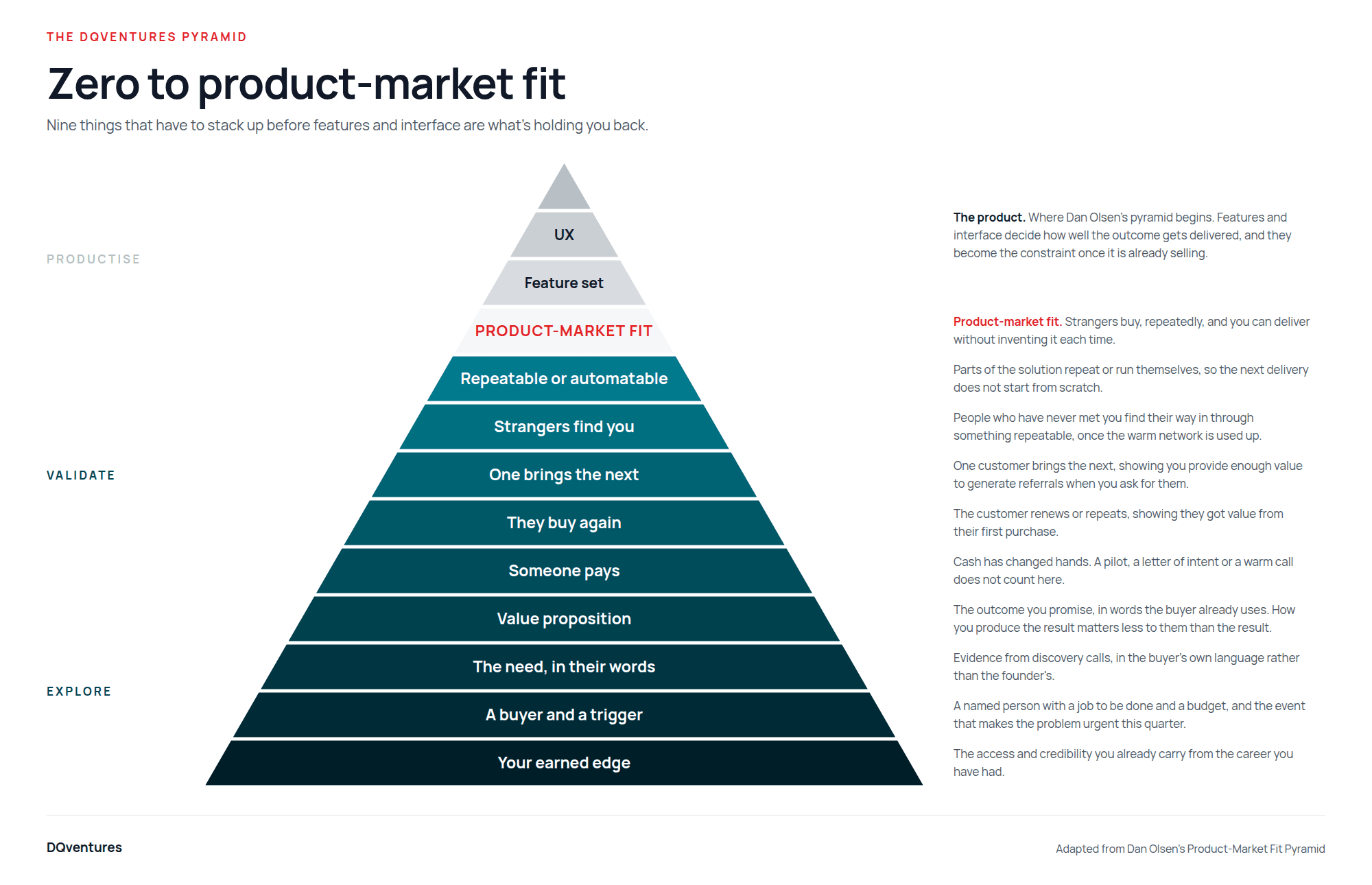
We've redrawn the diagram to show the typical founder's journey from zero to one.
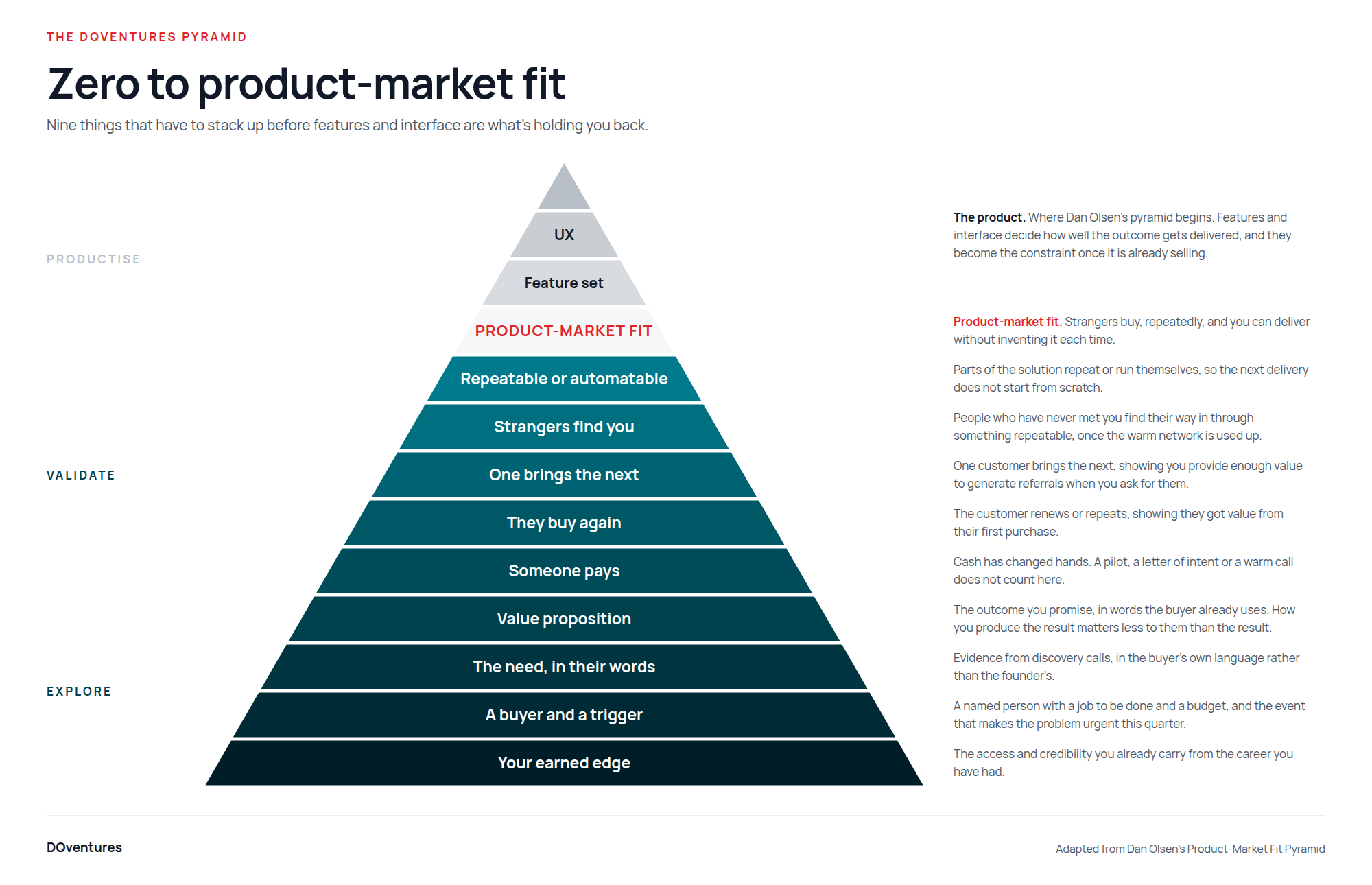 The DQventures pyramid: zero to product-market fit.
The bottom layer isn't the market
Olsen starts with the target customer. We start one layer lower, with the founder.
What business should you be building, based on your experience and your "earned edge". This refers to the access and credibility you've derived from your career so far. It's why somebody decides to take your call. It's why you can tell a real answer from a plausible one in an industry you've worked in for years, and why you already know which problems are merely annoying and which ones people pay to make go away. A first-time founder with no sector history has to build all of that from scratch. It's slow and expensive, sometimes barely even possible. You have it already, and as you start your journey into entrepreneurship it's usually the most valuable thing you own.
Earned edge sits at the bottom because everything above depends on it. You may be able to build a business outside your own area of experience, but it increases your chance of failure by at least an order of magnitude.
A buyer and a trigger
The next layer is a named person with a job-to-be-done and a budget, plus the event that makes the problem urgent right now. We draw on Miller Heiman's assertion that people buy if they're in trouble or in growth mode. Not when they're overconfident or "even keel". If there's no trigger, it's going to be a hard sell.
Most founders describe a segment. "SME manufacturers." "Early-stage founders." "HR teams." But a segment is not a buyer, and it's certainly not a buyer this month. What you want is a role you can name, in companies you can name, with money they already spend on something adjacent, and a trigger you can watch for: they just raised, they just failed an audit, the person who used to handle this just left.
Without the trigger your outreach list is everyone, and your message will probably land flat.
The need, in their words
Then evidence, from real conversations, in the buyer's own language.
This is the part most founders skip or do badly, because it's uncomfortable. In our experience, it's also the most easily identifiable factor dictating success or failure. In short, you have to ask people to describe their problem without telling them your solution. It's an exercise in keeping quiet and writing down the exact words people use. Rob Fitzpatrick's The Mom Test is the best short book on how to do this, and it's worth reading before your first call rather than after your tenth.
The test of whether you've done this properly is simple. Can you describe the problem using sentences the buyer actually said, rather than sentences you wrote? If your marketing isn't landing, chances are you're spending too much justifying your own value, and not enough time empathising with your customer's struggle.
Value proposition belongs below the line
This is where we part company with Olsen. He puts the value proposition above product-market fit, in the product half of his diagram. We put it below.
A value proposition is a promise about an outcome. The buyer doesn't care whether you keep that promise with software, a spreadsheet, or you personally doing the work on a Tuesday evening. They care about the result. You can make the promise, test it, and get paid for it long before there's a product to speak of, and you should, because the cheapest way to find out whether a promise is any good is to try selling it.
Then money, twice, then a referral
The next three layers are about the customer's behaviour.
Someone pays. Cash has changed hands. A pilot doesn't count. A letter of intent doesn't count. A warm call where someone said they'd definitely be interested counts even less. Real traction requires payment. It's proof of demand.
They buy again. This is where proof of demand becomes proof of value. A renewal or a repeat purchase is the first hard evidence that the first purchase delivered. It's not hard to sell once to a friendly contact, but a repeat purchase means you have to make the payment worth it.
One customer brings another. A referral, given when you ask for it, means the customer got enough value to put their own name on the line. This is a higher bar than a testimonial, and considerably more useful.
Strangers, then repeatability
Strangers find you. Most founders' warm networks produce a handful of early customers and then run dry, usually right around the time they've convinced themselves it's working. What they need is a way in for people who have never met them: a channel they can run again next month at a price they can afford.
Repeatable or automatable. The last layer below the line is what determines a scalable business from a lifestyle. Enough of the solution repeats, or runs itself, that the second customer doesn't start from a blank page. It doesn't need to be productised yet, but you need to know which parts of the work can be automated, because those are the parts that eventually become your product.
Where the line goes
For DQ founders, product-market fit sits above all nine of these sections. Strangers buy, repeatedly, and you can deliver without constantly reinventing your solution.
Above the line (which Olsen talks about) is what we call productising: the feature set and the user experience. Those decide how well the outcome gets delivered and how many customers you can serve without continually expanding the company's cost base. They matter enormously because they become the binding constraint once the outcome is already selling, but for us this is about the size of the opportunity, not about whether there's product-market fit.
If you're an early-stage founder, where you draw the PMF line is critical. Draw it where Olsen does and you'll be spending your time designing product features based on your own definition of "unmet needs". This is where most founders go wrong. Draw it where we do and the next sensible move is to find the person with the trigger and sell them an outcome you'll deliver by hand. Less sexy, harder work, but much more valuable when it comes to de-risking your startup journey.
What it's for
The reason we sequence the work this way is that it turns one overwhelming question, how do I build a business, into nine much smaller ones that each have an answer you can go and get in a week or two.
It also gives you a reason to stop doing the things that feel like progress and aren't. The logo. The deck. The roadmap. The addition of new product features before a single customer has paid you a penny.
If you're partway up the pyramid and something feels stuck, the layer below is usually the one worth checking before you build anything new.