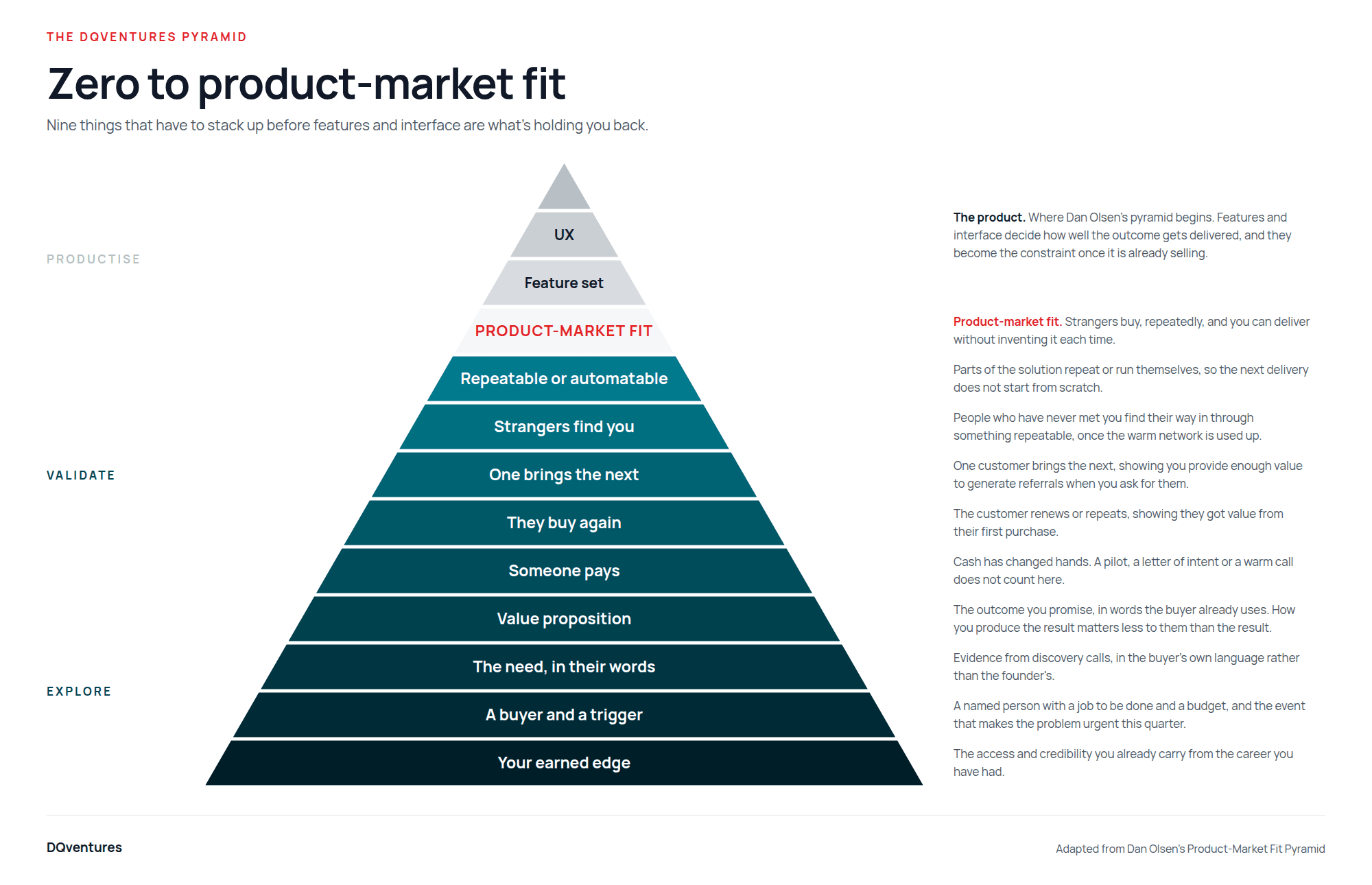
What every DQ founder gets at the end of Explore
Every founder who comes through Explore, the first month of building with DQ, ends up with one document that answers a single question: does the evidence support building this business?
You can download a full example at the bottom of this page. The founder, the company and the six people quoted in the discovery calls are invented, and we say so on the first page. Everything else is real. The competitors named are real companies, the procurement rules cited are real rules, and the market figures are sourced at the back so you can check them yourself.
What the month actually involves
Explore is four weeks on one idea. The founder runs discovery interviews with people who would be paying for this, we build a market and competitor analysis alongside those calls, and the hypothesis moves on GP calls as evidence comes in. Ideas get narrower most weeks. Some get replaced.
The Explore Stage Report is what that month adds up to. It marks the idea against DQ's four quadrants, twelve principles in total, and gives each one a verdict with the evidence attached. Every claim in it names a person, a quote, a number or a document. If a principle has nothing behind it, the report says so rather than filling the space.
Confirmed does not mean proven
The document opens by explaining what its own verdicts mean, and this is the part I would read twice.
A principle is confirmed at "I Believe" when there is evidence from real people in the target market and some observable behaviour behind it, usually money or time already going into a workaround. That is different from someone being encouraging on a call. The stronger standard, "I Know", arrives in Validate when a customer pays.
Naming that gap matters more than it sounds. Most people who leave a job to start something are working from I Believe evidence while telling themselves it is I Know. Writing the distinction down, in a document you keep, makes that harder to do by accident.
Founder Fit: why you
Earned Edge, Trusted Relationships, Drive and Character.
Most frameworks for evaluating a business idea leave you out of it, which is odd, because you are the largest variable. This section asks whether your edge took years to build and maps onto the thing you are selling, whether you already know the buyers, and whether your motivation and runway hold up.
The watchout is the part founders come back to months later. In the example, the founder describes himself as a generalist, and three of his six discovery calls ended with him offering help outside the plan: hiring a bid manager for one, a rate review for another. The report names the behaviour, quotes him saying it, and sets out the one thing that keeps it in check.
Market Fit: why this problem, now
Unsolved Pain, Buyer and Budget, Room to Win.
The discipline here is that money already spent beats verbal interest. "I'd pay for that" in a friendly conversation is worth something, and it is not worth as much as somebody who has already hired a freelancer to patch the problem.
This section also keeps the contradicting evidence in. One contact in the example tells the founder her scores are fine and she loses on price, which cuts against his whole hypothesis. It stays in the document, and it is part of why Buyer and Budget comes back partially confirmed rather than confirmed.
Solution Fit: why this version of it
Narrow Wedge, Asset-Light, Manual to Productised.
The wedge has to be a trigger moment: a specific event that makes the problem urgent this week. A customer type is too broad to test. In the example the trigger is a tender return date five days out, which is a date the buyer cannot move.
Asset-Light asks whether you can deliver the first paid version with your own time and a few hundred pounds of tools. Answering that properly is what decides whether you need to raise money before you have a customer, and the answer is usually yes, you can, and no, you don't.
Opportunity Fit: why this becomes a $10m business
Predictable Revenue, Scalable Economics, Viable Flywheel.
This quadrant gets no verdicts, on purpose. At the end of Explore nobody has paid, so anything said about recurring revenue, margins or referral loops is reasoning rather than a finding. Each principle gets a belief and the specific way that belief could be wrong. A report that handed out confident verdicts on this section would be flattering you.
The summary table, and what happens next
Twelve verdicts on one page. You can see at a glance which parts of your idea stand on evidence and which stand on hope, which is a useful and occasionally uncomfortable thing to look at.
The document then closes with three to five things Validate has to prove. The first is always a real customer paying a real price, with a name, a number and a date against it. In the example that is £2,000 from one of four named contacts, before the October tender returns. Everything else in the plan follows from whether that happens.
Then the decision is yours
At the end of Explore you own the work and you own the IP. You can take the report and run the plan yourself, keeping 100% of the business. Or you carry on with us into Validate, where we go after your first five paying customers together.
In the 12 months to August 2026, 46 founders have been through Explore. Of these, we invited 50% to continue into Validate. For the remaining 50%, the most common reason for not continuing is lack of demand from customers.
Almost without exception, founders finish the Explore month a lot clearer about what they should be building. Some decide not to pursue their idea at all, some choose to pivot, and others decide to go away and build on their own. Although obviously we're doing this to help launch (and be part of) successful businesses, as long as the founders make these decisions without giving up their job, we consider each of these options a success.
A founder who spends four weeks working out that their idea is less exciting than they originally hoped has still had a good month. This costs a great deal less than finding out the same thing twelve months later.
Download the example
Download the Explore Stage Report example, Redline (PDF)
If you only read two pages of it, read the summary table and then whichever principle came back partially confirmed. That is where the real work sits.