How the best founders and investors play an infinite game
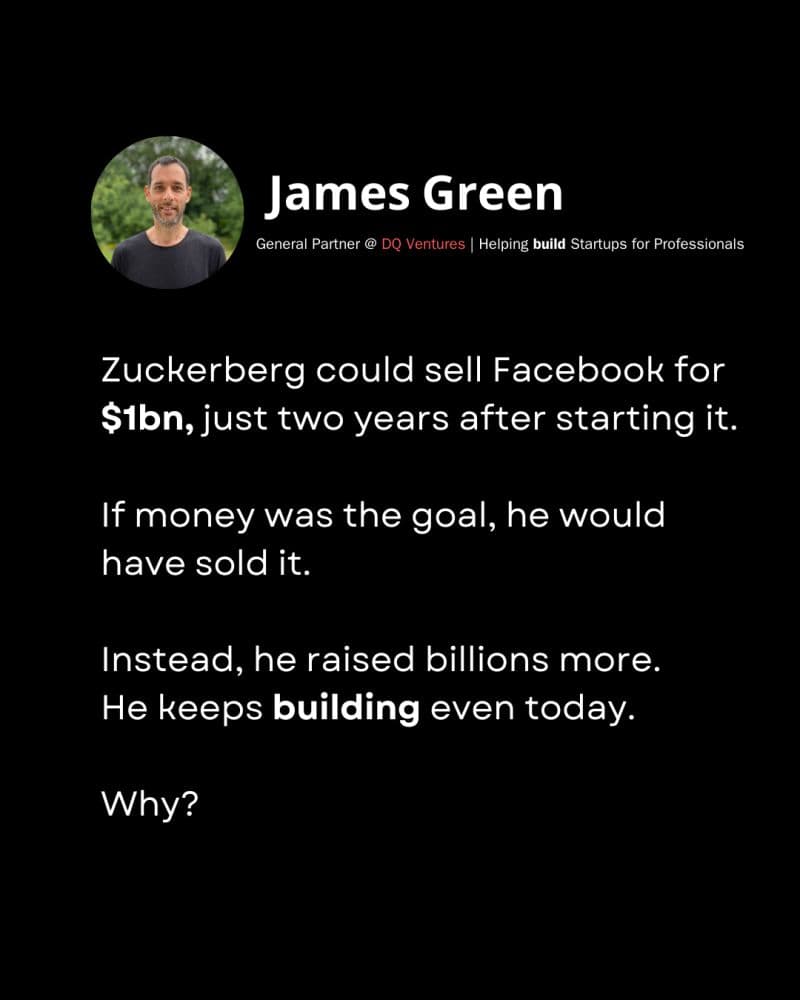
Many outsiders think Venture Capital is all about exits & valuations.
But game theory suggests it’s about much more than that.
The best founders and VCs play an infinite game, not a finite one. Here’s what I mean ↓
They use capital as fuel. Generating more capital (and wealth) isn’t necessarily the end goal here but a means to an end.
Look at Zuckerberg. He had the opportunity to sell Facebook for $1bn about two years after starting the company. If wealth had been his goal, he’d have sold. It’s more money than most people could spend in a lifetime.
Instead, he raised billions more, which enabled him to do way more than sell a company… he built—and continues to build—his own version of the future.
They understand the importance of influence and control. VC is about converting capital into an improved human experience.
Just as Zuckerberg went to extraordinary lengths to maintain control over the future, many VCs will do the same VCs aren’t investing in founders; they’re investing in megatrends and trying to identify the most likely teams and companies to dominate them.
They are masters of their domain. Not to go too “Zuckerberg” on you, but as Spotify founder, Daniel Ek, recently said of him at an Acquired event:
”He’s probably the best learner I’ve ever seen. You can have a conversation with him about a topic and he may not know very much about it, and then the next time he would know more than, I would say, most experts about the subject.”
The best startup folk stay curious and relevant, no matter what happens.
They value relationships, systems and impact above money. 8 in 10 VCs say their network is the key to their success. Not their fund size. Not their exits.Their relationships. (I’m sure they like money too, but 80% can’t be wrong?)
The same can be said for many founders. Ever talked to a founder a few months after a big exit? They’ll probably tell you that sailing into the sunset isn’t all it’s cracked up to be. Before long, many end up starting another company.
→They don’t trade away their freedom. Remember we’re talking about “the best founders”, not all founders. Did you know that Sequoia fires 45% of their portfolio company founder-CEOs within 18 months of investing?
In contrast, some founders know that autonomy in time and decisions is priceless. They play the game on their own terms, for as long as they want. And they’re impossible to get rid of (look at how Sam Altman has survived at OpenAI, despite all sorts of mutiny and disagreements among team members, shareholders and others.
What other traits do you think separate the best in our industry from the rest?