My £12m exit went up in smoke. Here’s what it taught me
Before closing down my first startup, we became an acquisition target for a large, listed business with headquarters in London. The agreed sale price was £12m (around US$14m at the time).
Had the acquisition taken place, all of our investors would have made money.
My cofounder and I would have earned ~$3m each (tax free, as we both lived in Singapore at the time, where there’s no capital gains tax).
More importantly (for me at least), we would have avoided having to shut down and explain to our investors that their money was gone.
In truth, the purchase always felt like a long shot.
We had no clients to speak of, so they’d be buying our tech and our team.
But it was a closer call than we anticipated.
The company’s board voted 5 for / 5 against, leaving the casting vote to the chairman. He was the person who had introduced us to the company in the first place. Our champion!
Could this be happening, after all?
No. The chairman abstained.
I was reminded of this moment when reading Phil Knight’s book, Shoe Dog. It’s an autobiography and the story of Nike — a fantastic book.
It also illustrates how Nike—a ubiquitous brand that seems somehow inevitable today—spent more than a decade on the brink of collapse.
At one memorable point the Bank of California, Nike’s bank at the time, decided to shut off Nike’s credit facility (Nike’s formal name then was “Blue Ribbon Sports”). In fact, it would close their account.
The manager, a Mr. Holland, explained the bank wanted no further part in the company’s high risk, high growth strategy.
In an instant, Nike’s future prospects fell entirely on Japanese trading company, Nissho Iwai, which was acting as the company’s financier and bank guarantor. More specifically, it came down to one man – Nissho’s local representative, a Mr. Ito.
Pull the rug or double down…?
This was Ito’s decision:
‘“Gentlemen,” he said, though he was speaking only to Holland, “it is my understanding that you refuse to handle Blue Ribbon’s account any longer?” Holland nodded. “Yes, that’s right, Mr. Ito.” “In that case,” Ito said, “Nissho would like to pay off the debt of Blue Ribbon — in full.”’
And so, one man’s decision changed history.
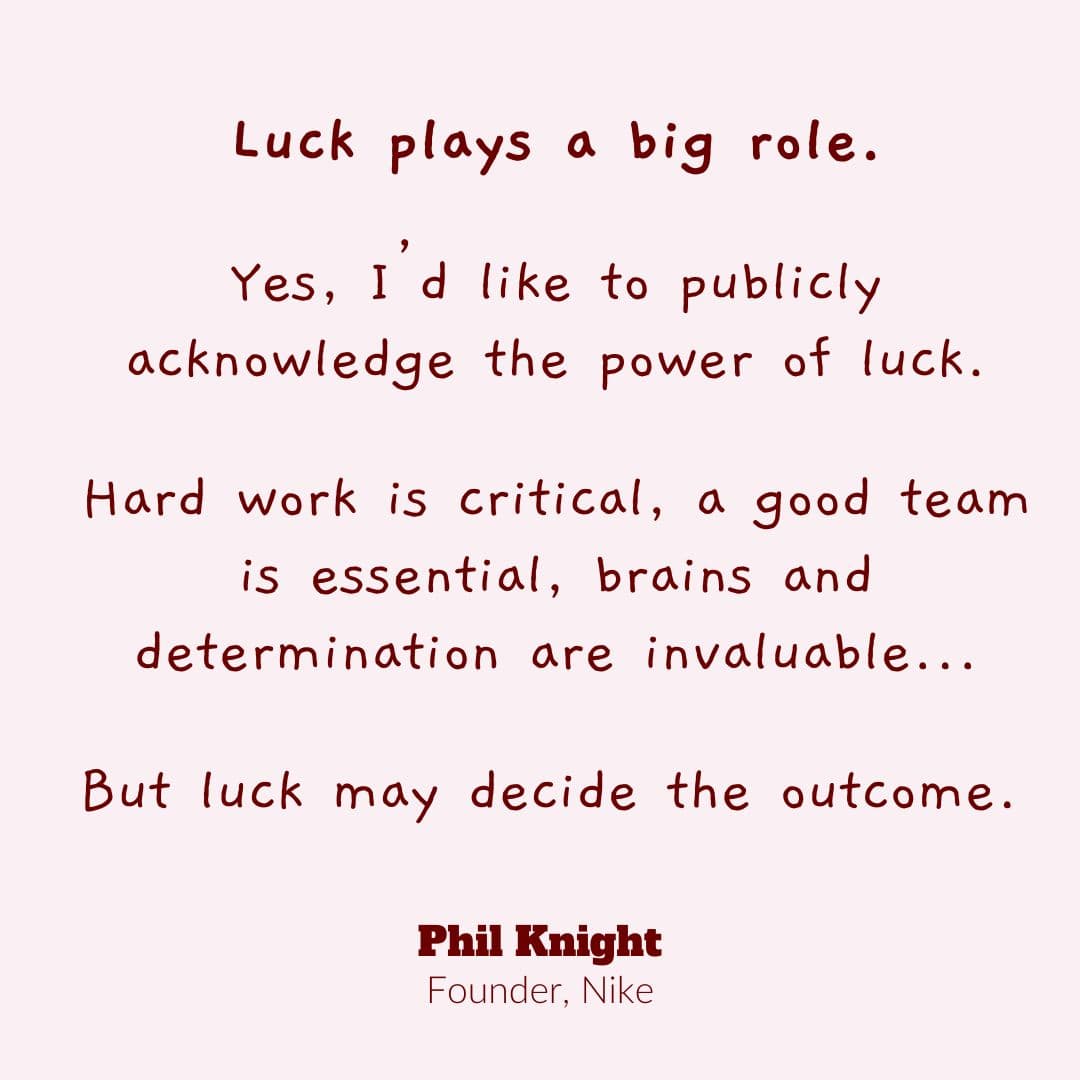
From massive success stories like Nike to my own little startup, so much can depend on these key moments, and on specific people… and on luck, as Phil Knight says himself.
No, I’m not comparing our company to Nike.
I’m not saying we were unlucky (although if we’d sold, I’d certainly have called it luck).
What I am saying is the difference between success and failure sometimes isn’t skill, or creativity or intellect (although Phil Knight and his team had these in abundance).
All-too-often, the deciding factor is the determination to keep going, the intuition on when to give up and when to keep pushing, and the ability to survive until luck changes.
It’s not an easy journey, but you’ll never stop learning.
If you haven’t already… read the book.